
Smarter buildings. Measurably lower energy bills.
Baseline energy for every zone, control HVAC by schedule or threshold, and keep water, fire safety and air quality in check. AI forecasts consumption and tells you where to save.
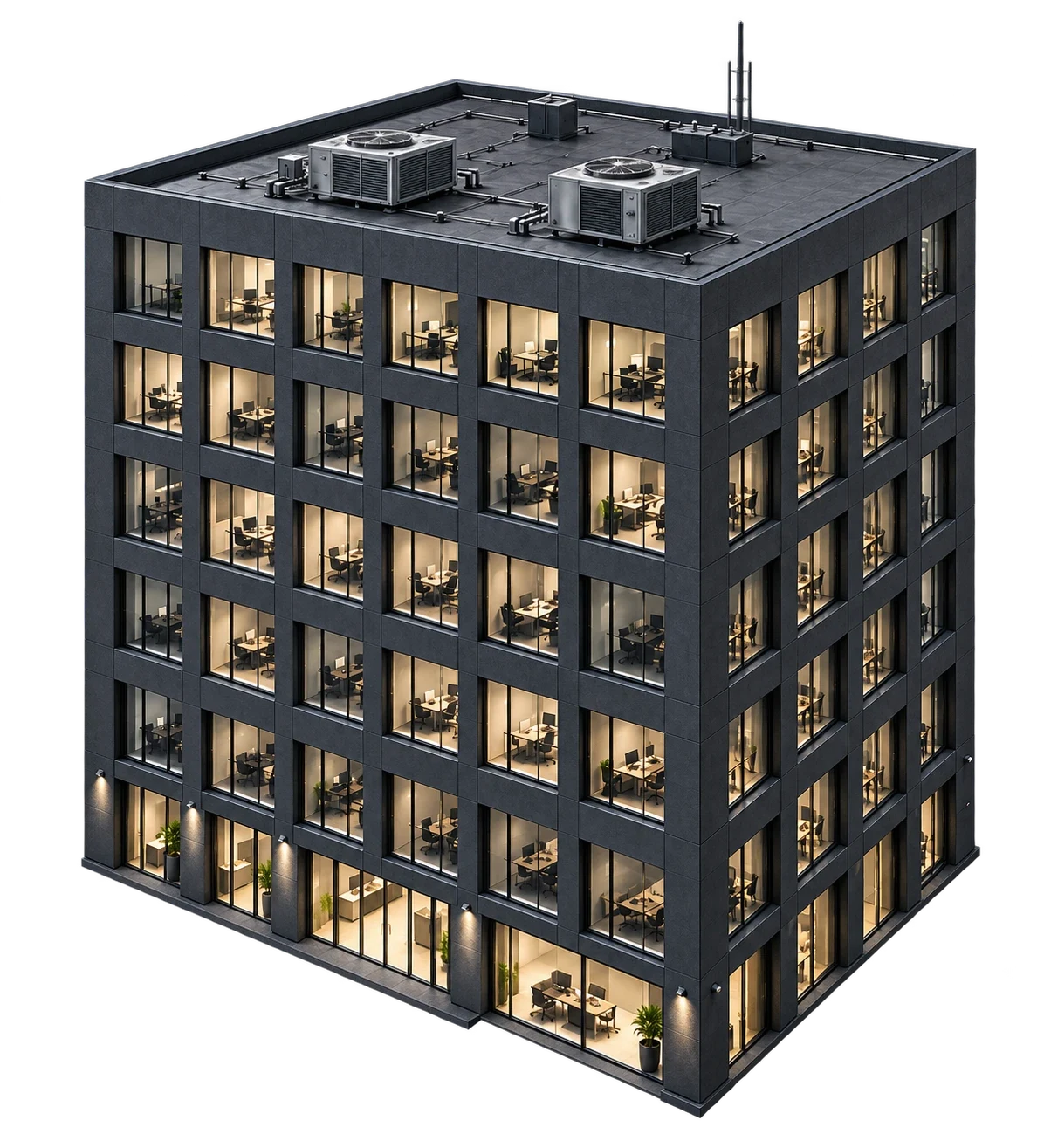
From fixed schedules to a building that optimises itself
An AI layer on top of the HVAC digital twin predicts load, comfort and faults, then turns every insight into an action that cuts energy while protecting comfort and equipment life.
The digital twin learns how every zone behaves
Schedules and thresholds stay as the safety base. The AI forecasts load and comfort hours ahead, then picks the lowest-energy plan that keeps every zone in range.
- Optimal start and stop: reach comfort right at occupancy, coast on stored cooling at the end of the day
- Set-point and VFD optimisation: chilled-water, supply-air and fan speeds reset against load, weather and tariff
- Chiller sequencing and VRF capacity matching for the best kW/TR
- Adaptive thresholds and occupancy setback for idle units in empty zones
Every change is simulated in the twin first. Rule limits and manual override always win.
Every insight becomes a ranked, explained action
Forecasts, the optimisation engine, health models and operating patterns all feed one queue of proposed actions, scored on savings, risk and urgency.
- Plain-language reason for every action, with expected kWh, cost and comfort impact and a confidence level
- Execution mode per action: advisory, approve-to-apply, or automatic within limits
- Owner and due time so nothing waits in an inbox
- Closed-loop verification: the real saving is measured and used to rank future actions
Accepted, rejected and automated actions are all logged and verified against the AI baseline.
Forecast every zone, prove every saving
Consumption is forecast per zone, per equipment group and for the whole building. Savings are proven against an AI baseline of what the building would have used without the measures.
- Four horizons: next hour for peak demand, next day for pre-cooling, next week and month for budgets
- Disaggregation into chiller, AHU, VRF, split AC and non-HVAC loads
- Verified savings = AI baseline − actual, in kWh, cost and CO₂, in line with IPMVP Option C
- What-if analysis for set-point changes, operating hours or a chiller replacement
Fix it before it fails
Every chiller, AHU, VRF unit and split AC gets a live health score. The AI learns each unit's own normal, spots the drift, names the likely fault and predicts when it will hurt comfort or efficiency.
- Learns normal behaviour of power, speed, pressure and temperature under each load and weather
- Filters context such as start-up, defrost and mode changes to avoid false alarms
- Diagnoses the fault by combining AI with HVAC engineering rules
- Raises the work order: approved maintenance goes straight to the CMMS
Technician findings on each work order become training data, so accuracy improves every maintenance cycle.
Ask anything about your HVAC, in plain language
Engineers and supervisors get answers grounded in live BMS data, the digital twin, AI predictions and the building's own documents.
- Grounded and sourced: every answer links to the points, time ranges and documents it used
- Searches the building's knowledge: OEM manuals, error codes, SOPs and maintenance history
- Guided troubleshooting: likely causes in order, the checks to run and the SOP safety steps
- Acts within your role: acknowledge alarms, raise work orders, approve actions; equipment commands are simulated and confirmed first
AHU-3's supply fan is running at 50 Hz while its VAV dampers are about 70% closed, so the fan is pushing against high static pressure. Fan power is 18% above its normal for this load.
Every AI output ends in an action
Its measured result is fed back, so the models keep improving in your building.
Everything your building runs on, in one place
NSP installs the hardware, connects every system and runs it from one platform. Open any area to see how it works.
Energy monitoring and baselining
Live consumption and a baseline for every zone, so every saving is measured.
Learn more →HVAC control and 3D digital twin
Run every unit by schedule or threshold, straight from Site Explorer or the twin.
Learn more →Water, fire and air
Tanks and water quality, every fire panel, and indoor air for each zone.
Learn more →Alarms, reports and mobile
The right alert to the right person, control from the phone, every action logged.
Learn more →Installation and commissioning
NSP supplies, installs and commissions the kit, from site survey to baseline.
Learn more →Open architecture
Equipment connects through NSP Envision Edge to NSP Cloud, and control flows back.
Learn more →
Questions, answered
How does NSP Envision iBMS measure energy savings?
It builds a baseline for the whole site and each zone, and the AI adjusts it for weather, occupancy and operating hours. Verified savings are the AI baseline minus actual use, in kWh, cost and CO₂.
What does the AI actually do?
It predicts load and comfort to control HVAC ahead of time, ranks proposed actions in the AI Command Center, forecasts energy and savings, predicts equipment faults, and answers questions through the AI Co-Pilot.
Will the AI change settings on its own?
Only if you allow it. Each action can be advisory, approve-to-apply, or automatic within limits you set. Every change is simulated in the digital twin first, and manual override always wins.
Do you install the equipment, or only provide software?
Both. NSP installs and commissions HVAC and chiller optimization equipment, sensors, smart lighting and flow meters, then configures them in NSP Envision iBMS.
Which protocols does it support?
Equipment connects to NSP Envision Edge over BACnet, Modbus and LoRaWAN, and the Edge talks to NSP Envision iBMS over MQTT. OEM APIs are supported too.
Find out how much your building could save
We'll walk through NSP Envision iBMS with a building like yours, from baseline to AI forecast.